

Fiber Consistency
Uniform dispersion supports stable slurry flow and more even material distribution.
Our bagasse tableware production process converts prepared sugarcane fiber pulp into molded plates, bowls, clamshell containers, food boxes and compartment trays for commercial foodservice orders.
Production is arranged around the approved product specification, mold, quantity and packing requirement. From pulp preparation and wet forming to hot pressing, trimming, inspection and packing, each stage has a direct effect on product shape, surface finish, structural consistency and shipment readiness.
The exact production settings vary by product size, depth, wall structure and mold design.
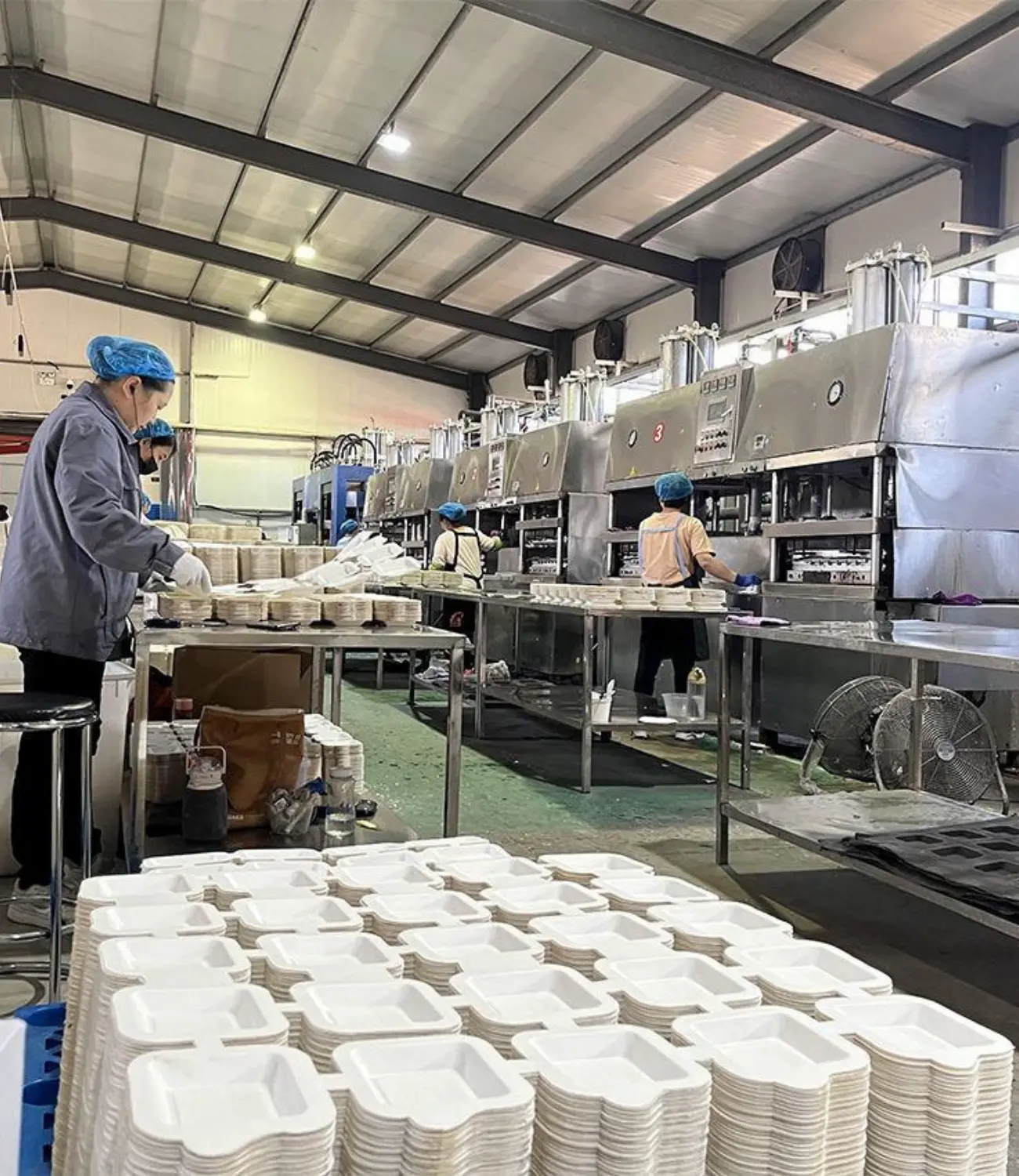
The workshop follows a connected molded-fiber workflow. Each stage prepares the material or product condition required by the next stage.
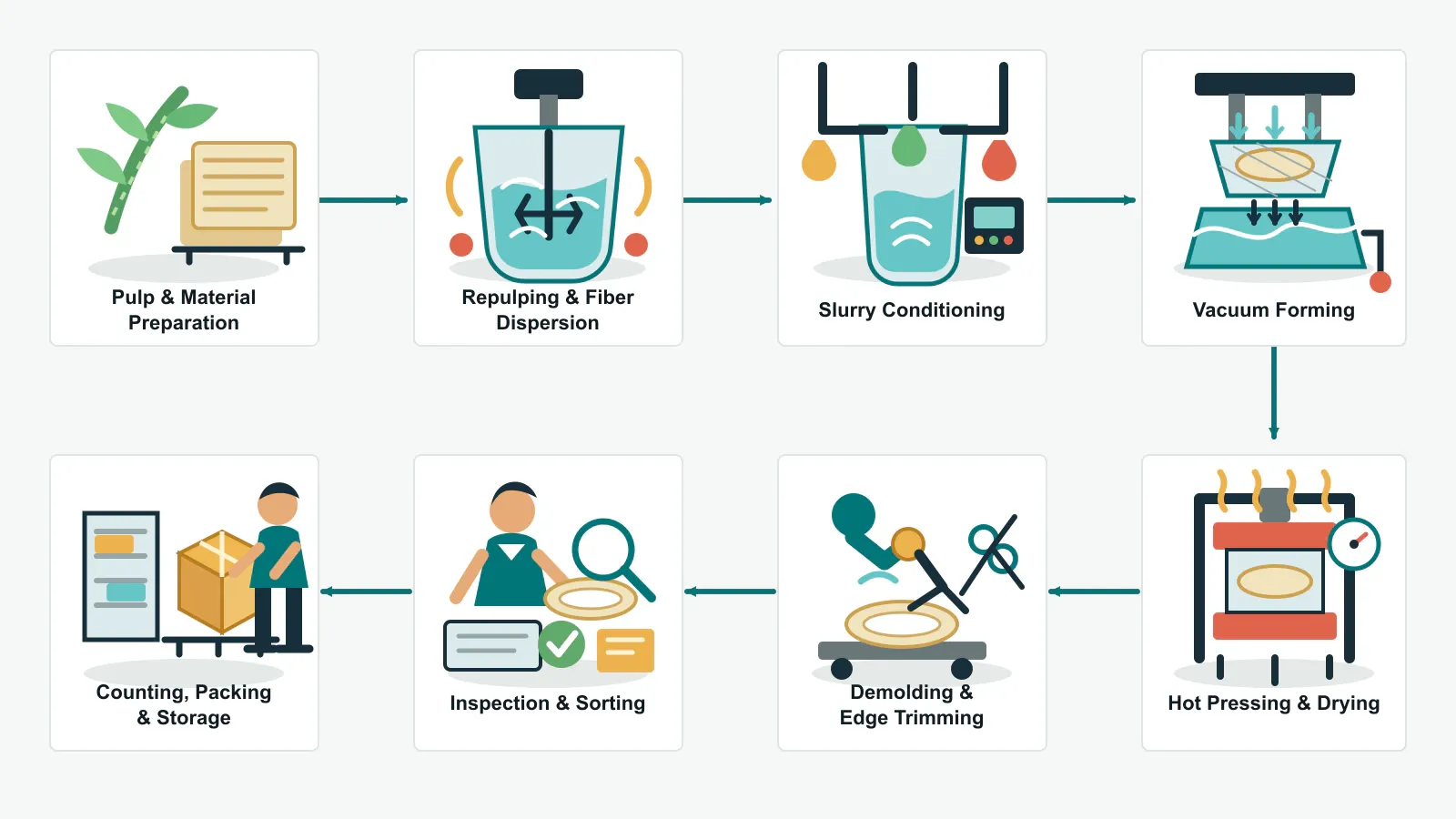

Stable molded-fiber production begins before the pulp reaches the forming machine. Material identity, fiber dispersion and slurry condition all influence how evenly fibers collect on the mold.
The required pulp is arranged for the scheduled product. Material handling should protect the pulp from contamination and unintended moisture exposure while maintaining clear identification for the production batch.
Prepared pulp is mixed with process water and mechanically dispersed. This breaks down compressed pulp sheets or fiber bundles and creates a pumpable slurry. Uniform dispersion helps reduce clumps and supports more consistent fiber distribution during forming.
The slurry is circulated and adjusted to suit the selected product and mold. Where a product specification requires functional treatment, the applicable formulation is confirmed separately. Slurry consistency is important because it affects drainage, forming time, product mass distribution and surface quality.
Forming and hot pressing are the central stages of the sugarcane bagasse tableware manufacturing process. They convert the prepared slurry into a stable three-dimensional foodservice product.
The forming mold carries a screen surface shaped to the plate, bowl, clamshell, box or tray design. Vacuum draws water through the screen while fibers remain on the mold and build a wet layer. Mold geometry, slurry condition, vacuum distribution and forming time all affect wall formation and material distribution.
After sufficient water removal, the wet preform is transferred from the forming station to the heated pressing molds. Controlled transfer is important for maintaining the intended outline, compartment walls, hinge areas and other structural features before final drying.
Heat and pressure remove remaining moisture while the matched molds define the final surface and dimensions. This stage helps compact the fiber network, improve rigidity and stabilize the product shape. Actual settings depend on the mold, product depth, wall structure and target result, so they are controlled as production parameters rather than treated as one universal setting.

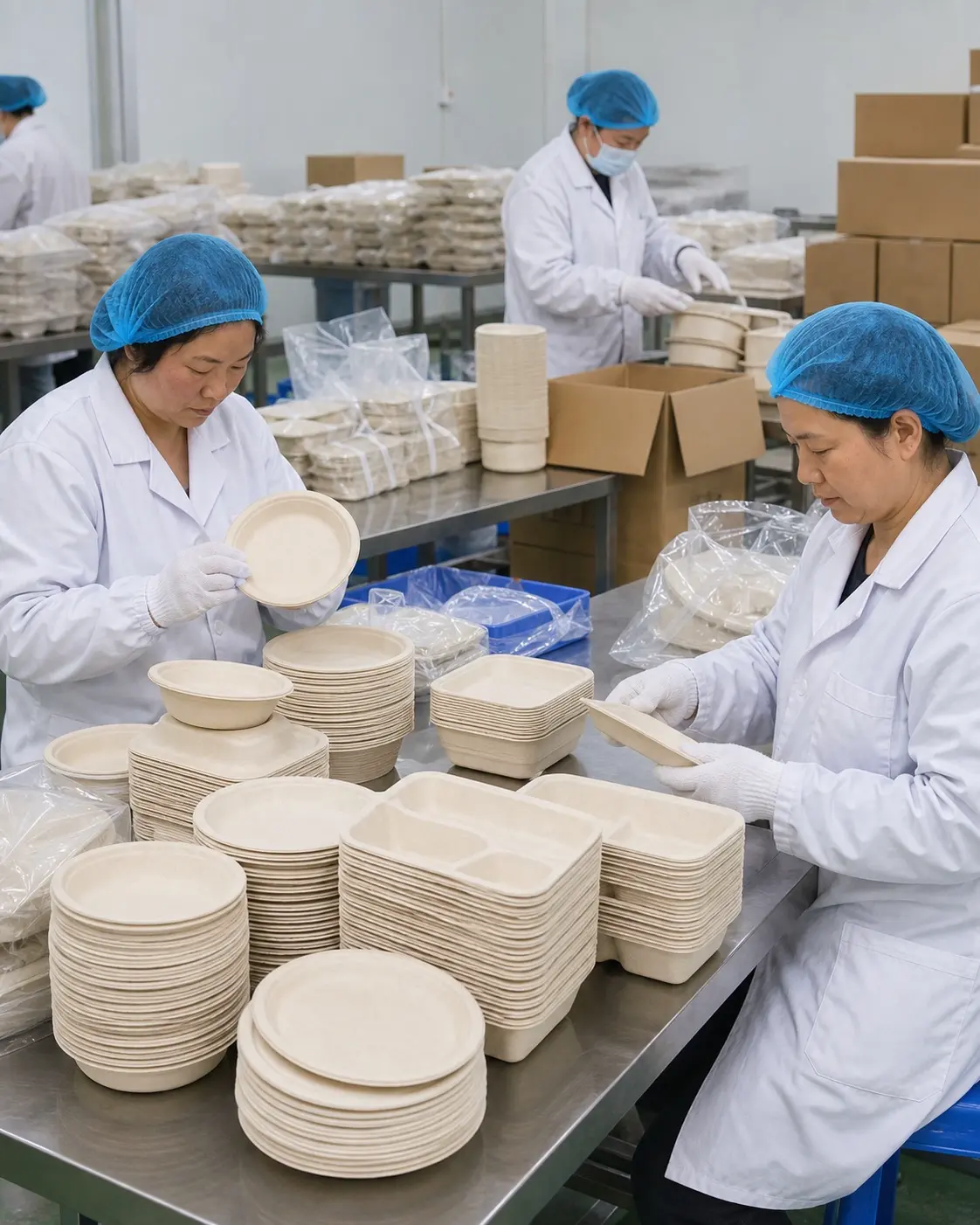
A molded product is not ready for shipment immediately after hot pressing. Finishing and order-control steps prepare it for commercial packing and help keep the delivered goods aligned with the approved specification.
Excess fiber around the molded edge is removed to create the required outline. Operators also review the formed shape for visible issues such as incomplete edges, cracks, deformation or surface marks before the product continues to sorting.
Inspection covers appearance and dimensions against the confirmed item specification. Depending on the product and agreed inspection plan, fit, closure, stacking or other functional characteristics may also be reviewed. Accepted and nonconforming products are separated before packing.
Products are counted and packed according to the approved bag, carton, label and private-label requirements. Quantity and packaging are checked before finished cartons enter storage. Loading details are then confirmed as the order is prepared for export shipment.
The production team connects material preparation, forming, finishing and packing so that each stage supports the approved order requirement.
Uniform dispersion supports stable slurry flow and more even material distribution.
Wet preforms are reviewed for complete shape formation before hot pressing.
Pressing and trimming affect dimensions, rigidity, surface condition and edge quality.
Appearance and dimensional requirements are reviewed before accepted goods are packed.
Quantity, bags, cartons, markings and loading preparation follow the confirmed order.
Practical answers for importers, distributors, foodservice companies and private-label buyers reviewing the production workshop.
The main material is prepared sugarcane bagasse pulp. Bagasse is the fibrous residue remaining after sugarcane juice extraction and can be converted into pulp suitable for molded-fiber products.
A screen mold with the required product geometry uses vacuum to draw water from the slurry. Fibers collect on the mold and form a wet preform, which is then transferred for heated pressing and drying.
Hot pressing removes moisture, consolidates the fiber structure and helps establish the finished dimensions, surface and rigidity. The production settings must match the specific mold and product design.
The process supports multiple bagasse tableware formats, including plates, bowls, hinged clamshell containers, food boxes, portion items and compartment trays. Each format requires the corresponding mold and approved specification.
Finished products are reviewed for appearance and dimensions, while quantity and packaging are checked against the order. Additional product-specific checks can be confirmed in the agreed inspection plan before mass production.